

Microdiscectomy is an operation that removes the small piece of slipped disc pressing on a nerve in your lower back. Dr. M. Abdur Rehman is a consultant neurosurgeon and spine surgeon in Faisalabad who specialises in endoscopic and microscopic (microdiscectomy) spine surgery. It is done through a cut of about two to three centimetres using a microscope. It treats taang mein dard, not back pain. Most people walk the same day and go home within one to two days.
Is microdiscectomy dangerous? Will I be paralysed?
This is the first question almost every family asks, so it belongs first. Paralysis after a lumbar microdiscectomy is very rare, and there is an anatomical reason patients are rarely told. The spinal cord ends high up, around the level of the lowest ribs. Below that point there is no cord at all, only a loose bundle of individual nerve roots floating in fluid. Most discs that need this operation sit at L4-L5 or L5-S1, well below where the cord stops. The structure people picture being cut is not even there.
That does not make it risk free. No operation is. The honest risks are infection, a small tear in the dural covering that is usually repaired during the same surgery, bleeding, and the disc herniating again later. These are uncommon and mostly manageable.
The other half of the answer matters just as much. A nerve that is being squeezed is also being damaged. If you already have a weak foot or numbness that is spreading, waiting is not a neutral choice. Weakness that has been present for months does not always come back fully, even after the pressure is taken off.
Do I even need surgery, or will my slip disc settle on its own?
Most back pain is not surgical. Most sciatica settles within six to twelve weeks without any operation. If your pain started recently, you can still walk, and your leg is not weak, the right first step is time, sensible painkillers and proper physiotherapy, not a date in theatre.
In Punjab most people try a hakeem, cupping, or a massage first. Gentle massage will not damage your spine. Forceful pulling or twisting on a nerve that is already compressed can make the leg pain worse, and the bigger cost is time. Weeks spent that way are weeks nobody is checking whether the leg is getting weaker.
There are signs that change this and need seeing the same day, not next month. Trouble passing urine or holding it, numbness around the private area and inner thighs, or a foot that suddenly drops and slaps the floor when you walk. If any of these are happening, go to a hospital immediately.
An honest consultation should end with one of three answers: you do not need surgery, you may need it later so we will watch it, or you need it now and here is why. Many patients who come with an MRI and a fear of slip disc leave with a treatment plan and no operation.
What does slip disc ka operation actually remove?
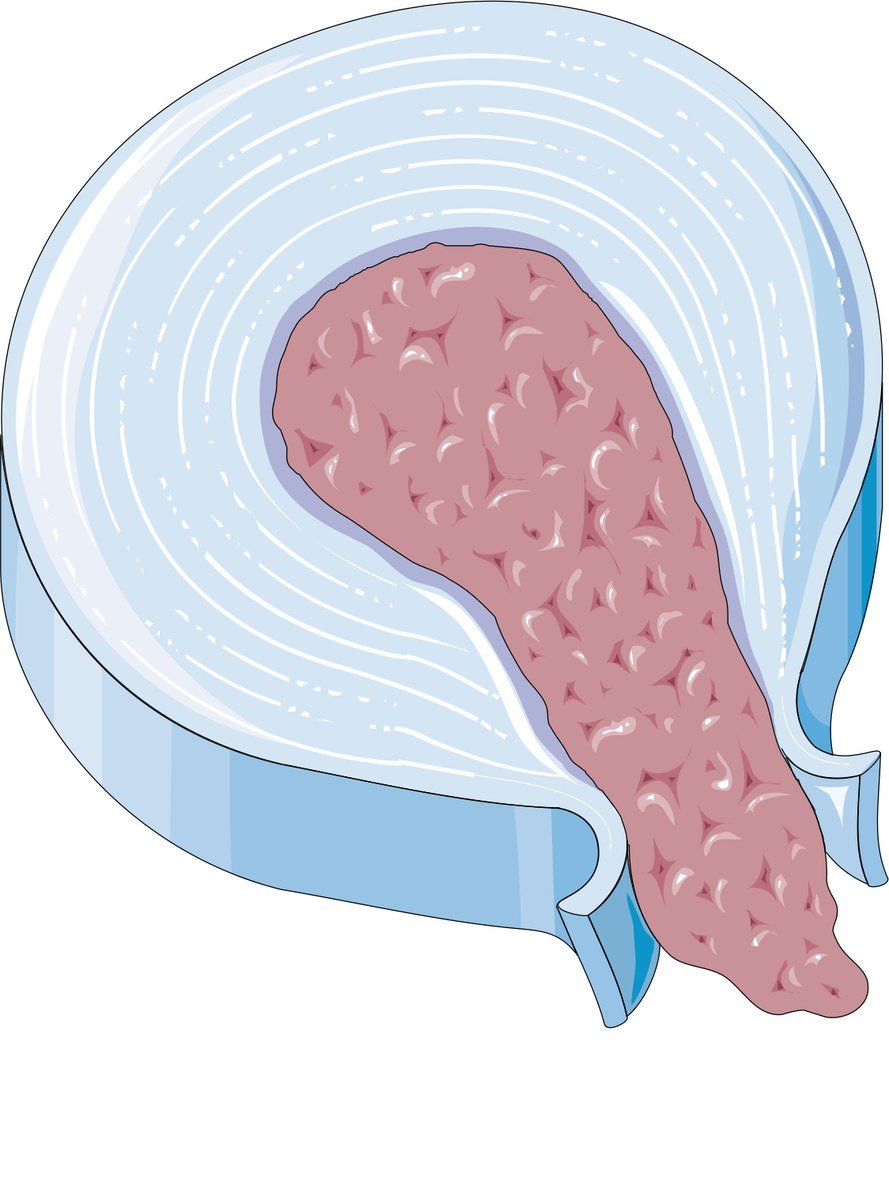
When people say slip disc ka operation, they usually picture the whole disc being pulled out and something being put back in its place. That is not what happens. The surgeon removes only the fragment that has escaped and is sitting on the nerve. The rest of the disc stays exactly where it is. No screws, no rods, no fusion, and your spine keeps its normal movement.
The word micro refers to the microscope and the small opening, not to a small problem. Through a cut of roughly two to three centimetres the back muscle is moved aside rather than cut through, a small window of bone is shaved to expose the nerve, and under the microscope the nerve root is gently lifted so the fragment underneath can be taken out. That is the whole operation.
Microscopic surgery of this kind has been performed for decades and remains the standard that newer techniques are measured against. In Urdu the condition is called slip disc, although nothing has actually slipped. The tough outer ring of the cushion has torn and the soft centre has pushed through it.
Am I a candidate for microscopic disc surgery?
Microscopic disc surgery is aimed at leg pain, not back pain. The people it helps most share a clear pattern: pain, numbness or weakness running down one leg below the knee, an MRI showing a disc pressing on the nerve root that matches that exact leg and that exact area of numbness, and six to twelve weeks of proper non-surgical treatment that has not worked.
It is also offered sooner when there is progressive weakness in the leg, or urgently when there are bladder and bowel symptoms.
The clearest way to be let down by this operation is to have it for the wrong reason. A microdiscectomy done for kamar dard alone, with no leg pain and no matching disc on the MRI, will fail however well the surgery itself goes. That is the honest warning worth hearing before any date is booked.
Some scans point instead to endoscopic discectomy, which reaches the same fragment through a puncture and a camera. Both work. Microdiscectomy tends to suit large, migrated or calcified fragments and repeat operations. Your MRI decides, not a preference for one tool.
What happens on the day of the operation?
You are admitted, blood tests and a physician or cardiac clearance are checked, and you are kept fasting. The operation is done under general anaesthesia and commonly takes about an hour, though setting up and waking up add to the time you are away from the ward.
Afterwards you wake in recovery with the leg pain usually already much smaller. Most patients are helped out of bed and walking within a few hours. Some back soreness at the incision is normal and is not a sign anything has gone wrong.
One night in hospital is common, and some patients go home the same evening. You will leave with wound care instructions, painkillers, a walking plan and a follow-up date.
How long does recovery take after microdiscectomy?
The leg pain is the fast part. The taang mein dard that stopped you standing in one place is usually gone or much reduced the day after surgery. The rest follows a fairly predictable shape: short walks several times a day in weeks one and two with no bending or lifting, longer walking and real sitting by weeks three and four, then a review around week six when most restrictions come off if healing is normal.
Driving yourself is commonly two to three weeks, once you are off strong painkillers. Desk work often restarts around three to four weeks. Heavy manual work, long motorbike rides and the gym usually wait until about three months.
These are ranges, not promises. Age, weight, diabetes, smoking and how long the nerve was compressed before surgery all move the timeline. Somebody who had severe leg pain for three weeks generally recovers faster than somebody who suffered for two years.
One honest warning. Numbness and pins and needles recover slowest. A patch of numbness on the foot or outer calf can take months to fade, and in some people a small patch never fully goes. That is not a sign the operation failed.
What does microdiscectomy cost in Faisalabad?
The cost varies with the hospital, the room category, the anaesthesia and the length of stay, so no honest figure can be given on a web page. Ask for a written, itemised quote in PKR before you agree to anything, and treat a verbal number as incomplete.
A useful quote separates the surgeon's fee, the anaesthesia, the theatre charge, the hospital stay by room type, the medicines and the follow-up visits. Then ask the one question most families forget: what is not included. Repeat scans, physiotherapy and an extra night on the ward are the usual gaps.
If you are travelling in from Jhang, Sargodha, Toba Tek Singh or a village outside the city, also ask how many days your family should plan to stay and what follow-up will need you to come back.
How do I arrange a consultation in Faisalabad?
People searching for the best spine surgeon in Faisalabad for a slip disc usually want the same thing: an honest look at their own MRI.
Dr. M. Abdur Rehman is a consultant neurosurgeon and spine surgeon at Mujahid Hospital, Faisalabad. You can request an appointment through this website or by contacting the hospital.
Bring your MRI films and the written report, not only the CD, since films can be read straight away. Bring any older X-rays, your current medicine list, and reports for diabetes, blood pressure or heart problems. Bring the family member who will be part of the decision, because in most Pakistani families that decision is not made alone.
If you are travelling from out of town and are not sure your scans are enough, ask before you make the journey. And if the answer after reading your MRI is that you do not need an operation, you will be told that plainly.
Questions patients ask about this
Is microdiscectomy a major operation?
It is real surgery under general anaesthesia, so it is not a small thing. But as spine operations go it sits at the safer end. Nothing is fused, no screws or rods go in, and the cut is about two to three centimetres. Most people walk the same day and go home within one to two days.
Can the disc slip again after surgery?
Yes, it can. The rest of the disc stays in your back, and a fresh fragment can push out again through the same tear. It is one of the known risks of the operation and it happens to a minority of patients. Avoiding heavy lifting, bending and smoking in the first three months gives you the best chance.
Will slip disc ka operation cure my kamar dard?
Probably not fully. Microdiscectomy is an operation for taang mein dard, the pain running down your leg. Back pain often improves too, but that is a bonus, not the aim. If your main complaint is kamar dard with no leg pain and no weakness, this operation is the wrong one for you.
Is endoscopic surgery better than microscopic disc surgery?
Neither is better in general. Published trials show similar leg pain relief and similar rates of repeat surgery. The endoscopic route uses a smaller opening and usually means less bleeding and a shorter stay. Microdiscectomy suits large, migrated or calcified fragments and repeat operations. Your MRI decides which one fits you.
What should I bring to the first appointment?
Bring your MRI films and the written report, not just the CD, along with any X-rays, your medicine list and reports of diabetes, blood pressure or heart problems. Bring a family member who will be part of the decision. If you are travelling from outside Faisalabad, ask beforehand what else to carry.
Ask about your own scan. Send your MRI or X-ray on WhatsApp and get a straight answer on whether surgery is needed at all.
Dr. M. Abdur Rehman is a consultant neurosurgeon in Faisalabad. Send your scan on WhatsApp and ask what it actually shows.
Two clinics in Faisalabad, each with its own timing. Mujahid Hospital, Madina Town, Susan Road, Faisalabad: 4:00 PM to 7:00 PM. IDC, 563-B, Satiana Road, Faisalabad: 8:00 PM to 9:00 PM. Message before travelling to check availability on the day.
Read more before you decide
What is a microdiscectomy?
A microdiscectomy removes the slipped disc fragment pressing on a nerve. What it treats, whether it is safe, recovery time and cost in Faisalabad.
Read thisMicrodiscectomy recovery: driving, sitting and going back to work
Microdiscectomy recovery explained: when you can drive, sit comfortably and return to work, plus honest advice on whether you need the surgery at all.
Read thisIs microdiscectomy dangerous? Risks explained
Is microdiscectomy dangerous? A Faisalabad neurosurgeon explains the real risks, the chance of paralysis, and when back surgery is not needed at all.
Read this