

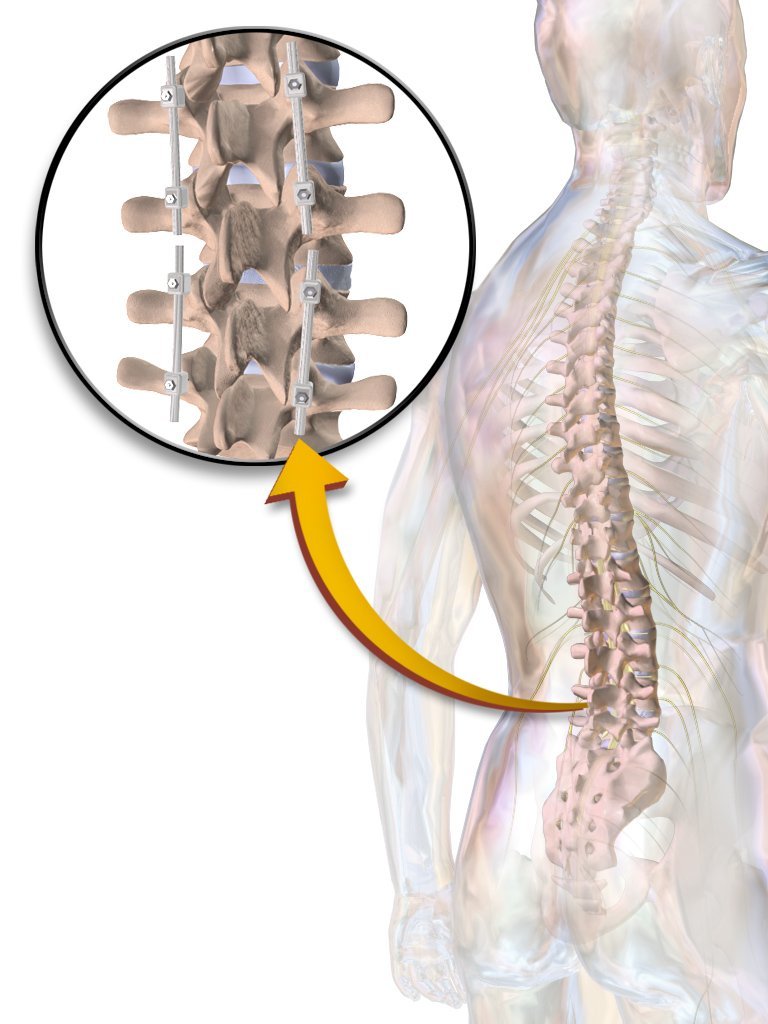
Spinal fusion joins two or more vertebrae into one solid bone, usually with titanium screws and rods. Dr. M. Abdur Rehman, consultant neurosurgeon at Mujahid Hospital, Faisalabad, performs fusion for an unstable or slipping spine, not for ordinary kamar dard. Most back pain and most slip disc cases need no fusion at all.
Is spinal fusion dangerous? Will I be paralysed?
Permanent paralysis after lumbar spinal fusion is rare. Most fusions are done in the lower back. The spinal cord ends near the top of the lumbar spine, and below that the nerves run as separate loose roots in fluid. That anatomy is one reason serious cord injury is uncommon at this level.
Rare does not mean impossible, and this is still a real operation. The risks a surgeon should name for you are infection, bleeding, a leak of spinal fluid, a screw that sits badly and needs repositioning, and nerve irritation that leaves numbness or a weak foot. With fusion there is also the chance that the bone does not join, which doctors call non-union.
Say your fear out loud in the consultation. Ask what could go wrong in your case, with your MRI, at your levels. You are entitled to that answer before you sign anything. If a surgeon tells you there is no risk at all, ask someone else.
Do I really need spinal fusion, or is someone rushing me?
Most people with kamar dard do not need spinal fusion. Most people with a slip disc do not need it either. Fusion is for a spine that is unstable, meaning the bones shift against each other in a way they should not. A painful back is not automatically an unstable back.
Before fusion is discussed, you should have had a fair trial of supervised physiotherapy, weight control, and changes to how you lift, sit and travel. Weeks, not two visits. Many patients arrive after months with a hakeem, oil malish or repeated injections, with no proper imaging and no examination. That time is only wasted if nobody ever actually looked at the spine.
If you have been offered screws and rods and you feel unsure, take a second opinion. That is normal and expected, and no good surgeon is offended by it. Carry your MRI CD and the written report, not only the printed film.
What is spinal fusion, and what do the screws and rods actually do?
Spinal fusion joins two or more vertebrae so they heal into a single block of bone. The pressure is first taken off the squeezed nerve. Then bone graft is packed between the vertebrae, often with a small spacer called a cage, and titanium screws and rods are fixed to hold that level still while the bone grows across.
The screws are not the fusion. They are the scaffolding. The real fusion happens quietly over the following months, as your own bone bridges the gap. Once that bridge forms, the segment no longer bends. That is the trade you are making. You give up movement at one or two levels so a loose, painful segment stops shifting. If it was never loose, you have given up movement and gained nothing.
Words you may hear in the clinic or see written on a quote: spinal fixation and instrumented fusion both simply mean screws and rods were used. Pedicle screws are the screws that anchor into the bone. TLIF and PLIF mean the fusion was done from the back. ALIF means it was approached from the front of the abdomen.
Am I a candidate for spinal fixation?
Fusion is considered when the problem is structural. The usual reasons are a vertebra slipping forward over the one below it and still moving on bending X-rays, a spine that has become crooked, certain fractures, infection or tumour that has weakened the bone, and some cases where a trapped nerve cannot be freed without removing so much bone that the level is left loose.
The symptoms that push the decision towards surgery are taang mein dard that will not settle after months of proper treatment, a walking distance that keeps shrinking, or real weakness in the foot or leg. Numbness between the legs, or loss of bladder or bowel control, is an emergency. Go to a hospital the same day. Do not wait for an appointment.
Your MRI alone does not decide this. Almost every adult past forty has something on the report. The decision comes from matching the MRI to your symptoms and to what is found on examination.
What does spinal fusion cost in Faisalabad?
Nobody can give you an honest price over the phone. The cost is built from parts, and the parts change with the case. The biggest single item is the spinal implants: screws, rods and cages. After that comes the number of levels fused, the approach used, hospital and room class, and your own health, since diabetes or heart disease can mean more tests and a longer stay.
Ask for a written, itemised quote in PKR on hospital letterhead after your consultation. It should list surgeon fee, anaesthesia, implants, operating theatre, room, tests and follow-up as separate lines. An estimate is still an estimate. If a complication or an extra night in hospital changes the figure, that should be explained to you and your family at the time.
You are allowed to ask which implants are being used and who makes them. Fusion is one of the more expensive spine operations in Pakistan, and in most families the decision is taken together, so bring the person who will be arranging the money to the consultation.
What happens on the day, and how long is the recovery?
Fusion is done under general anaesthesia. Before the date you will have blood tests, and a physician review if you are diabetic or have heart trouble. Tell the team about every medicine you take, including blood thinners, and about any herbal or hakeem preparations you are still using.
Most patients are helped out of bed the day after surgery and go home within a few days. Walking early is encouraged. Light desk work is usually possible in weeks. The bone itself takes six to twelve months to set fully, and that part cannot be hurried. Smoking and uncontrolled blood sugar both work against a fusion healing, so both are worth dealing with before the operation.
You will be called back for follow-up X-rays. Please come, even if you feel completely well. Those films are how anyone knows the fusion is taking hold.
How do I arrange a consultation in Faisalabad?
Dr. M. Abdur Rehman is a consultant neurosurgeon at Mujahid Hospital, Faisalabad. Patients travel in from across Punjab, from Jhang, Sargodha, Chiniot, Toba Tek Singh and further out. If you are coming from out of town, telephone first so you are not making the journey twice.
Bring your MRI CD and the written report, any X-rays including bending films, operation notes if you have had spine surgery before, a list of your current medicines, and recent blood sugar and blood pressure readings. The CD matters more than the printed film, because the images can be scrolled through properly.
Bring a family member with you. These decisions are rarely taken alone, and it helps if the person who will be asking questions later is in the room. You will not be pushed into a date. If the honest answer is that you do not need fusion, you will be told that.
Questions patients ask about this
Will I be able to sit on the floor and pray after spinal fusion?
Most people return to sitting on the floor and to namaz, though it takes time and some find sajda and standing up easier with a little support at first. A one or two level lumbar fusion stiffens a small part of a long spine, and the rest of the back keeps moving. Ask your surgeon about your specific levels.
Do the screws have to be removed later?
Usually not. Titanium screws and rods are meant to stay for life. You can still have an MRI afterwards, though the metal causes some blurring close to the implants. Removal is considered only if an implant is loose, infected or clearly causing pain, which is uncommon. Hot weather and metal detectors are not a problem.
Can my kamar dard be cured without surgery?
For most people, yes. Ordinary kamar dard responds to supervised physiotherapy, weight control, better lifting and time. Fusion is not a treatment for muscular or joint back pain, and no honest surgeon will promise that it is. Surgery enters the discussion when a nerve is compressed or the spine is genuinely unstable.
How long will I be off work after spinal fixation?
It depends on your work. Desk and shop work is often possible within a few weeks, with breaks to stand and walk. Driving, heavy lifting, carrying loads on the head, and farm or factory labour take much longer, often several months. The bone needs six to twelve months to set fully. Ask for a written plan for your job.
Should I take a second opinion before agreeing to fusion?
Yes, and nobody should be offended by it. Fusion is permanent and expensive, so a second look is reasonable. Take your MRI CD, the written report, bending X-rays and any notes you have been given. Ask the second doctor the same question: is my spine unstable, and what happens if I wait?
Ask about your own scan. Send your MRI or X-ray on WhatsApp and get a straight answer on whether surgery is needed at all.
Dr. M. Abdur Rehman is a consultant neurosurgeon in Faisalabad. Send your scan on WhatsApp and ask what it actually shows.
Two clinics in Faisalabad, each with its own timing. Mujahid Hospital, Madina Town, Susan Road, Faisalabad: 4:00 PM to 7:00 PM. IDC, 563-B, Satiana Road, Faisalabad: 8:00 PM to 9:00 PM. Message before travelling to check availability on the day.
Read more before you decide
What is spinal fusion, and when is it really needed?
Spinal fusion surgery joins vertebrae into one bone. When it is truly needed, when it is not, recovery time, risks and costs for patients in Pakistan.
Read thisSpinal fusion cost in Pakistan: what to ask
Spinal fusion cost in Pakistan: what actually drives the price, what a written quote must list, and how to know whether you need fusion at all.
Read thisSpondylolisthesis: when one vertebra slips forward
Spondylolisthesis treatment explained simply: what the grades mean, when physiotherapy is enough, when fusion is needed, and how to decide in Pakistan
Read this